


You Don’t Have to Earn Your Rest: A Reflection on the Four of Swords
I really feel like there’s a particular kind of tiredness that creeps in towards the end of the year.
The days are getting shorter, the evenings are darker, and perhaps you’ve started to notice that your energy isn’t quite what it was a few months ago. There are still things to do, people to see, responsibilities to manage and plans to make. Christmas is approaching, and that brings its own collection of expectations and demands.
So, rather than feeling able to slow down as the darker months might be calling you to, you may instead just find yourself thinking about everything you still need to get done.
But what if you could embrace the idea that rest isn’t something you have to earn?
Rest isn’t a reward
I wonder how many of us have an unspoken agreement with ourselves that we can rest once we’ve done enough?
We might not consciously think of it like that, but it can show up in all sorts of ways. Feeling guilty when we sit down while there’s washing to be done. Finding it difficult to enjoy a quiet afternoon because we’re thinking about what we should be doing. Telling ourselves we’ll take a break once we’ve finished one more thing.
Sometimes, even when we do stop, we don’t really switch off. Our minds are still busy making lists, anticipating problems and mentally organising everything that needs our attention.
I don’t want you to see this as another task, but I think it’s worth being curious about where some of these expectations come from …
Perhaps you grew up in a family where being busy was valued, where hard work was praised and sitting around was seen as being lazy. Perhaps you learned that being helpful, productive or accommodating was a way of being appreciated or loved. Maybe you’ve become so accustomed to just getting on and managing everything that slowing down feels uncomfortable, even when you’re exhausted.
There can be a lot of history behind our relationship with rest.
And if we’ve come to associate our worth with what we achieve, it can feel surprisingly difficult to give ourselves permission to do nothing.
But rest isn’t a reward for good behaviour. It’s not something you have to earn by being productive enough, helpful enough or organised enough. We don’t even need to have a particularly good reason for wanting to rest. We don’t have to be exhausted, overwhelmed or struggling. We might simply want to stop for a while, and that, in itself, can be reason enough.
The Four of Swords: An invitation to pause
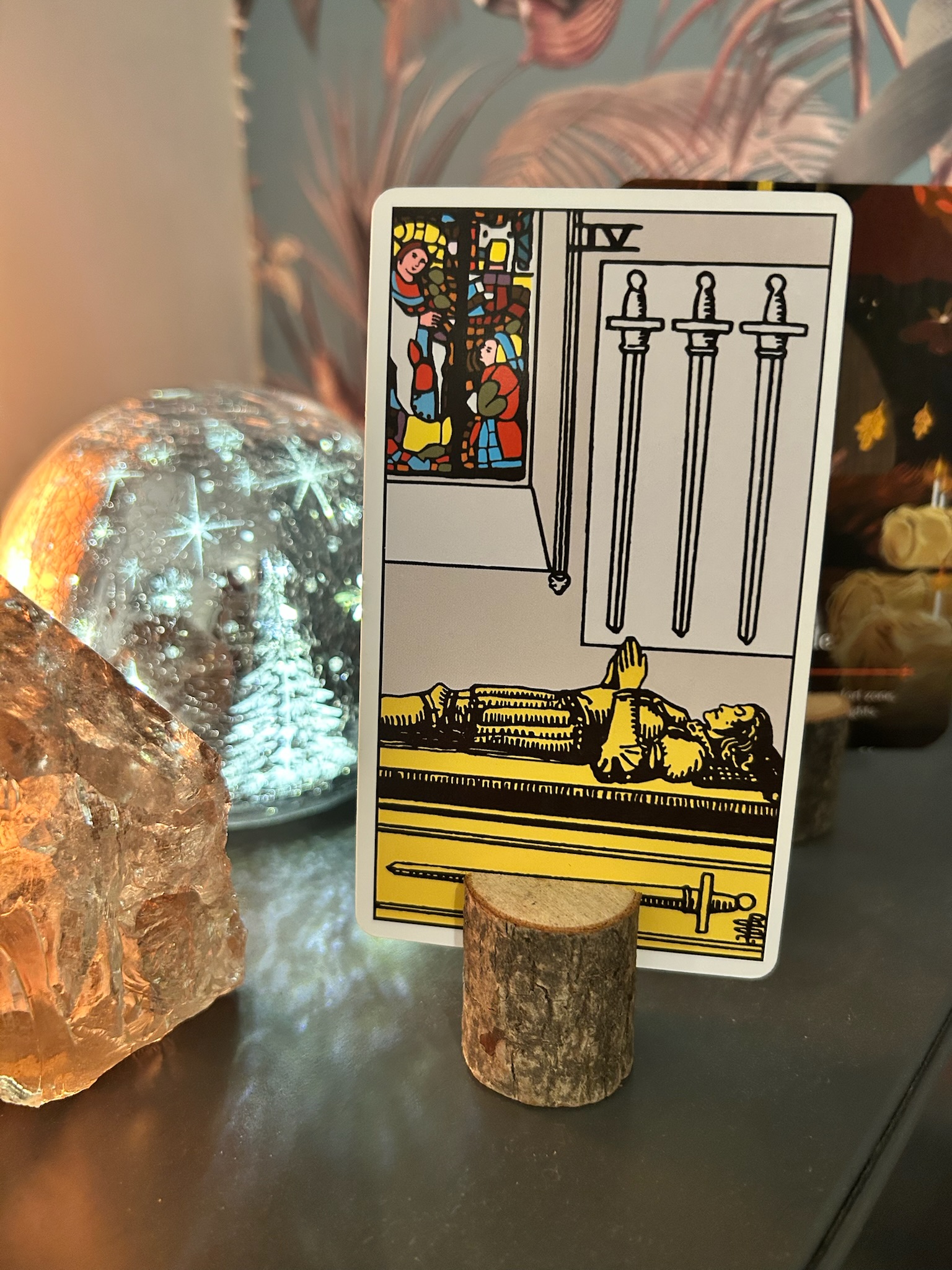
The Four of Swords is a card that feels particularly relevant to this conversation.
In the Rider Waite Smith tarot deck, we see a figure lying in stillness, with three swords hanging above them and another beneath them. The setting feels quiet, almost like a place of sanctuary. There is a sense of having stepped away from the demands of the outside world.
For me, this card speaks to the importance of creating space to pause.
Not because everything is finished. Not because we’ve finally done enough to deserve a break. But because sometimes we need to stop, take a breath and allow ourselves some time away from the things that demand our attention.
The Four of Swords doesn’t ask us to justify our need for rest. It simply invites us to recognise it.
There is also something interesting about the swords in this card. Swords are associated with the mind, thoughts, decisions and mental activity. So perhaps this card invites us to think not just about physical rest, but also about how and when we allow our minds some valuable respite.
What would it be like to have an hour without needing to make a decision, solve a problem, anticipate someone else’s needs or think about what comes next?
Often, that’s the kind of rest we need the most.
What does rest actually mean to you?
Rest doesn’t necessarily mean the same thing to everyone. It can look very different depending on who you are, what your life looks like and what you’re currently carrying.
It might mean an afternoon on the sofa with a book. For someone else, it might mean going for a walk, spending time in the garden or making something creative. It might mean saying no to an invitation, leaving the washing where it is or deciding that something can wait until tomorrow.
And sometimes rest means allowing yourself to stop being productive altogether.
I also want to mention that rest doesn’t always feel comfortable. If you’re used to being busy, slowing down can bring feelings of guilt, restlessness or anxiety. You might find yourself reaching for your phone, making another list or looking for something ‘useful’ to do.
Sometimes, keeping busy can also be a way of avoiding things we’d rather not think about. When we slow down, we might find ourselves having to sit with feelings or thoughts that we’ve been pushing to one side. Perhaps this is another reason why allowing ourselves to rest can feel so hard.
So, rather than seeing this as a sign that you’re getting rest ‘wrong’, how might it be if you approached it with curiosity …
What happens when you give yourself permission to pause? What thoughts or feelings come up?
Perhaps there’s something there worth listening to.
You don’t have to push through until Christmas
I’m writing this in mid-November, and at this time of year it’s easy to fall into the trap of thinking that we just need to get through the next few weeks.
We’ll rest after Christmas. We’ll slow down in January. We’ll look after ourselves once everything is sorted.
But Christmas is rarely the pause we hope it will be, and January doesn’t necessarily arrive with a magical supply of renewed energy!
Perhaps we need to start thinking about what we can leave undone, rather than desperately trying to find ways to fit everything in. What would Christmas look like if we weren’t trying quite so hard to make everything perfect?
So, what if, instead of waiting for everything to be finished, I invited you to look for small opportunities to rest along the way …
What if you allowed some things to remain imperfect? What if you lowered an expectation, changed a plan or decided that something didn’t need to happen at all?
And you don’t have to make your rest productive either. It doesn’t need to be part of a self-improvement plan or another opportunity to work on yourself.
Sometimes, it can simply be enough to stop.
A few questions to reflect on
If you’re finding it difficult to give yourself permission to rest, perhaps take a little time to consider some of these questions:
- What does rest mean to me, beyond simply sleeping or doing nothing?
- When do I find it hardest to allow myself to stop?
- What do I tell myself when I take a break but still have things to do?
- Where might I have learned that I need to be productive, useful or helpful to be deserving of rest?
- What might I be afraid would happen if I did a little less?
- What is one thing I could give myself permission not to do this week?
You might even like to spend a little time with the Four of Swords and notice what it brings up for you.
Perhaps the most important question is this:
What would change if you stopped treating rest as something you have to earn?
I’d really love you to know that you are allowed to pause. You are allowed to have needs. You are allowed to stop, even when there is still more to do.
Rest is not a reward. It’s part of being human.
If this has brought up questions about the expectations you place on yourself, or the difficulty you sometimes find in giving yourself permission to slow down, these might be things worth exploring. Counselling can offer a space to think about where these patterns come from, how they affect you and whether they still serve you. You can read about working with me here: Psychodynamic Counselling.